
A skill never belongs
to a single job.
Acting on one task means touching several roles at once. Without a map, every decision is a guess.
With all this complexity, how do you steer your shift to AI?
Our role: give you the visibility to steer — not decide for you.
AI doesn't take over jobs.
It takes over tasks.
The task is the unit of measure. The job is only a unit of aggregation, and the frameworks are the join key.
Job
Too broad to say anything about AI. A job is an average of tasks.
Task
The level where we measure. This is where AI takes over, assists — or does nothing.
Skill
What shifts when the task changes in nature: what will need to be learned, or passed on.
We say “most of this job's tasks are at H3,” never “this job is H3.”
Four measures per task.
The job is their weighted sum.
Agency
Set by expert judgment, double-validated, linked to public measurements from Stanford and Anthropic.
Desirability
“AI can do it” and “it should be done” are two separate questions. The second is collected in your company.
collected in your companyMaturity
From a tool already in place to established governance. A task can be H2 and M5: it will wait its turn.
Velocity
Stable, within the year, within a few months. An H3 is often a stage; an unstable H5, a point to watch.
Percentages: dominant level desired by workers, across 104 jobs — Stanford WORKBank (Shao et al., 2025), 844 tasks, 1,500 workers surveyed.
Cross desire with capability,
then decide.
What AI can do doesn't tell you what should be done. The matrix places each task, then two settings refine the sequence.
How the criteria are weighted remains your decision: the tool makes it explicit, it doesn't set it.
Zones from Stanford WORKBank (Shao et al., 2025).
Four categories of data.
We always tell you which one you're looking at.
Yours
Job descriptions, skills mapping, headcount by job.
Your words, your phrasing.
Research
Stanford WORKBank, Anthropic Economic Index, O*NET, ESCO, ROME, EU AI Act.
Public, dated, with its limits.
Enriched
The connections between your job descriptions and the frameworks; the job ↔ task ↔ skill links.
The Skillberg engine.
Qualified
Four qualifications per task, by expert judgment, double-validated.
You correct them in the tool.
No score travels naked.
A number without its confidence and coverage isn't a measure: it's an opinion.Four steps, three human checks,
one bridge to research.
The model pre-fills, a person decides. Every match and every qualification goes through human review before it enters the calculation.
Collect and normalize
Your job descriptions (PDF, Word) become tasks, skills and titles in a common format. Homonyms and duplicates flagged.
Match and enrich
The job, then each task and each skill, matched to the graph: automatic first, then human review, then a global cross-check.
Qualify
The four measures, task by task, double-validated. Each qualification carries its confidence level.
Synthesize
Roll up task → skill → job → chain. Produce the micro and macro views, and the decision tool.
The O*NET bridge
Each task gets its equivalent in the US framework, where Stanford and Anthropic took their measurements. That's what lets us map their measurements onto your tasks — with a confidence rate that is calculated, not declared.
We start with people,
not with the regulation.
What it is — and isn't
Steering at the job levelAn independent diagnostic, and you make the callsAn individual ratingAn action plan sold in advancePlan ahead at scoping
Hiring, assignment, promotion, evaluation: HR AI systems become high-risk. Our diagnostic is not an AI system; the tool you might build next could be, with you as the deployer.
Three reflexes
It isn't the individual freedom to use AI that drives adoption: it's giving teams a voice in how collective work is organized.
Scientists, not a prompt.
Beneath every engagement, our own infrastructure: a skills graph that mirrors ESCO, ROME, O*NET and five other frameworks. The same engine is open to your technical teams.
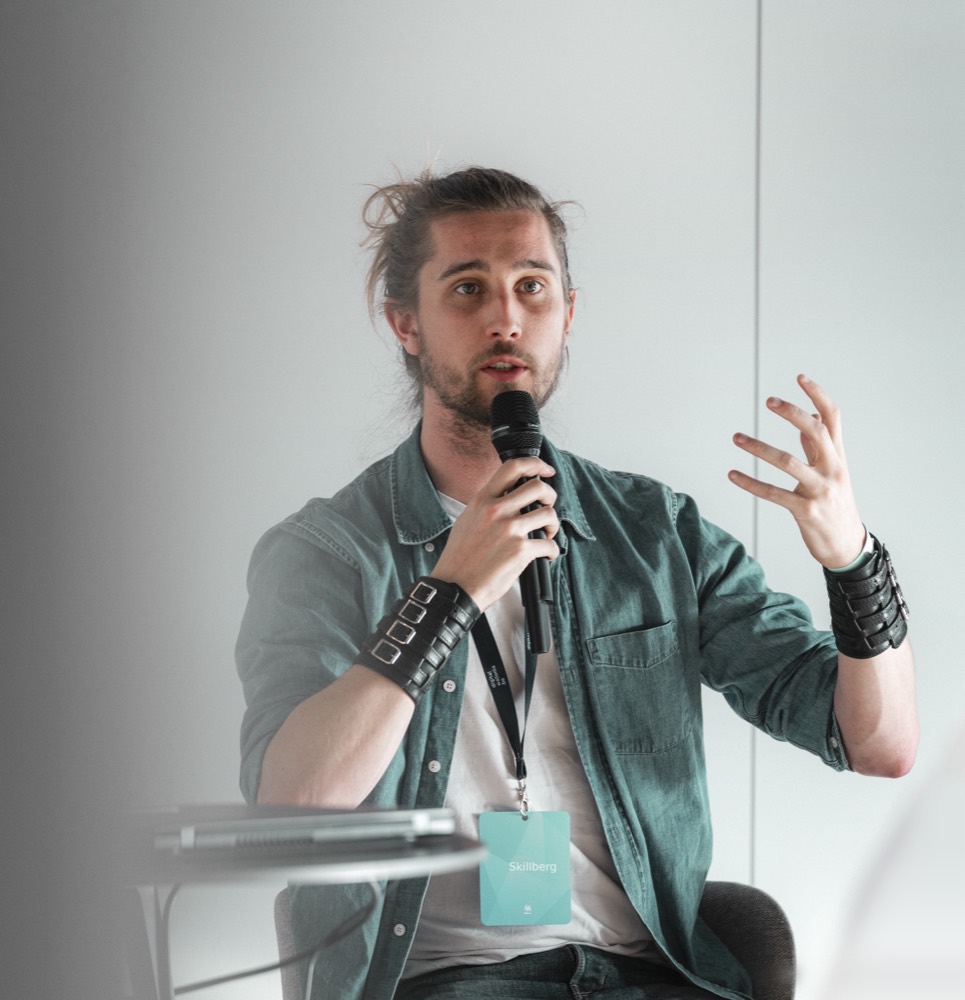
Martin Vielvoye
AI + neuroscience. Inventor of Skill Trees.
Based at Euratechnologies, Lille.
A lab that goes out into the field.
AI and data science research, a PhD in progress, an HR perspective. We built our own graph, on our own data, because no decision about jobs should rest on a black box.
Meet the team