
Talk about AI with employee representatives
with facts rather than promises.
For CHROs and labor relations managers who must inform and consult the works council (CSE) on the arrival of AI. Without a precise answer on which jobs are affected, distrust sets in quickly. We help you come to the meeting with facts everyone can check.
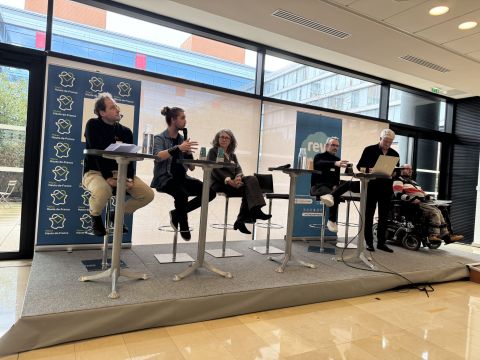
“Is AI going to cut our jobs?”
A works council member asked the question bluntly, in session. In the hallways, it was already going around. You know silence feeds rumors, but you don't want to promise what you don't know yet.
The worry is more nuanced than it seems. According to Stanford (2026), among the 28% of respondents who express a concern, the top one is AI's reliability (45%), well ahead of replacement (23%).
The works council will be consulted: better to come with facts.
The works council must be informed and consulted on the introduction of AI, as with any new technology, and its risks are added to the occupational risk assessment document (DUERP). For “high-risk” HR tools, the AI Act also requires informing employee representatives before the tool is put into service.
AI doesn't replace jobs, it changes tasks: that's the level of detail you can show. In sales administration, it takes over order entry, the relationship with loyal customers stays human, and checking the follow-ups it drafts becomes a new task.
LaborIA, a program of the French Ministry of Labour and Inria, puts it simply: deploying AI is “a new starting point”, built with staff and their representatives.
A basis for dialogue your works council can check.
The details: how the tool produces it.
What AI changes, job by job
Task by task, with visible assumptions you correct together, in session if needed.
No individual assessment
No one is assessed, and no personal data is used. It's the first thing your works council will check.
Your teams' voice
Anonymous questionnaires gather what they want to hand over to AI, or keep. Their reservations become topics for discussion.
« The place AI takes in our world will be the one we build for it. »
What labor relations managers ask.
What do we tell the works council about jobs?
The truth, in figures: the time returned in each job, in hours and full-time equivalents, and what leadership plans to do with it. Training, reassigning, protecting the tasks that train juniors: that's the material for your workforce planning.
Will the works council see it as a surveillance tool?
No, and that can be checked: the tool rates no one, tracks no individual performance and processes no personal data. You can say so from the first session.
What data do you use?
Your job descriptions, your headcount per job and the average time spent per task, nothing personal. The details: data and security.
Prepare your next works council meeting.
In 30 minutes, you tell us where labor relations stand in your company, we show you on a fictional company the report you can share with a works council, and together we sketch what a pilot would produce for yours.
30 minutes on video with Skillberg, no commitment. No personal data required.
- Shao et al., Future of Work with AI Agents, Stanford University, arXiv v3, February 2026 (preprint; 1,500 US workers, 844 tasks), p. 9
- LaborIA (French Ministry of Labour and Inria), Guide du déploiement de l'IA au travail [guide to deploying AI at work], March 2025, p. 7
- LaborIA (French Ministry of Labour and Inria), Étude des impacts de l'IA sur le travail [study of AI's impacts on work], 2024 summary, pp. 2 and 4-6
- Regulation (EU) 2024/1689, Article 26(7)